
What Makes a Handwoven Scarf worth $190?
The honest answer, from the person who makes them.
There's a version of this post where I try to justify the price by listing hours and materials and the cost of running a floor loom in an Adelaide studio.
I'm not going to do that.
Not because those things aren't real - they are - but because that's not actually the question you're asking when you look at a $190 scarf and feel your stomach do that small, hesitant thing.
The real question is: will I feel like an idiot for spending this?
And underneath that: is this actually for someone like me, or is it for a different kind of person - someone with a bigger budget, a cleaner house, a more sorted life?
So let's talk about that instead.
There's a version of this post where I try to justify the price by listing hours and materials and the cost of running a floor loom in an Adelaide studio.
I'm not going to do that.
Not because those things aren't real — they are — but because that's not actually the question you're asking when you look at a $190 scarf and feel your stomach do that small, hesitant thing.
The real question is: will I feel like an idiot for spending this?
And underneath that: is this actually for someone like me, or is it for a different kind of person — someone with a bigger budget, a cleaner house, a more sorted life?
So let's talk about that instead.
The Thing About Cheap Scarves
You've bought the cheap ones. We all have. The $19.95 one from the market, or the one that came in a gift set, soft in the shop and somehow wrong the moment you got it home.
It sits in the drawer. You don't hate it. You just never reach for it.
That's not a coincidence and it's not you being precious. It's the difference between something made to a price point and something made to actually be worn.
Machine-made scarves - even beautiful ones, even expensive ones - are made in batches. Thousands of them, identical, optimised for consistency. The variation is engineered out. What's left is a product.
A handwoven scarf is the opposite of that process.
What Actually Goes Into One of These Scarves
Here's what happens before a scarf arrives at your door.
First, there's the loom. A floor loom isn't a craft tool in the way a pair of knitting needles is a craft tool. It's a machine that takes up floor space in my home studio, worth a few thousand dollars, and operated entirely by the human sitting at it. Eight shafts, hundreds of individual threads, each one wound on and tensioned by hand before a single pass of the shuttle happens.
That setup alone - called warping, or 'dressing the loom' - takes hours. For one scarf run.
Then the weaving begins. And this is where it gets interesting, because a floor loom doesn't automate the pattern. Every row is a decision. Foot on the pedal, shuttle through the shed, beat the weft into place. Repeat. The rhythm becomes meditative after a while, which is part of why people who weave tend to keep weaving - but it is not fast, and it cannot be rushed without the fabric showing it.
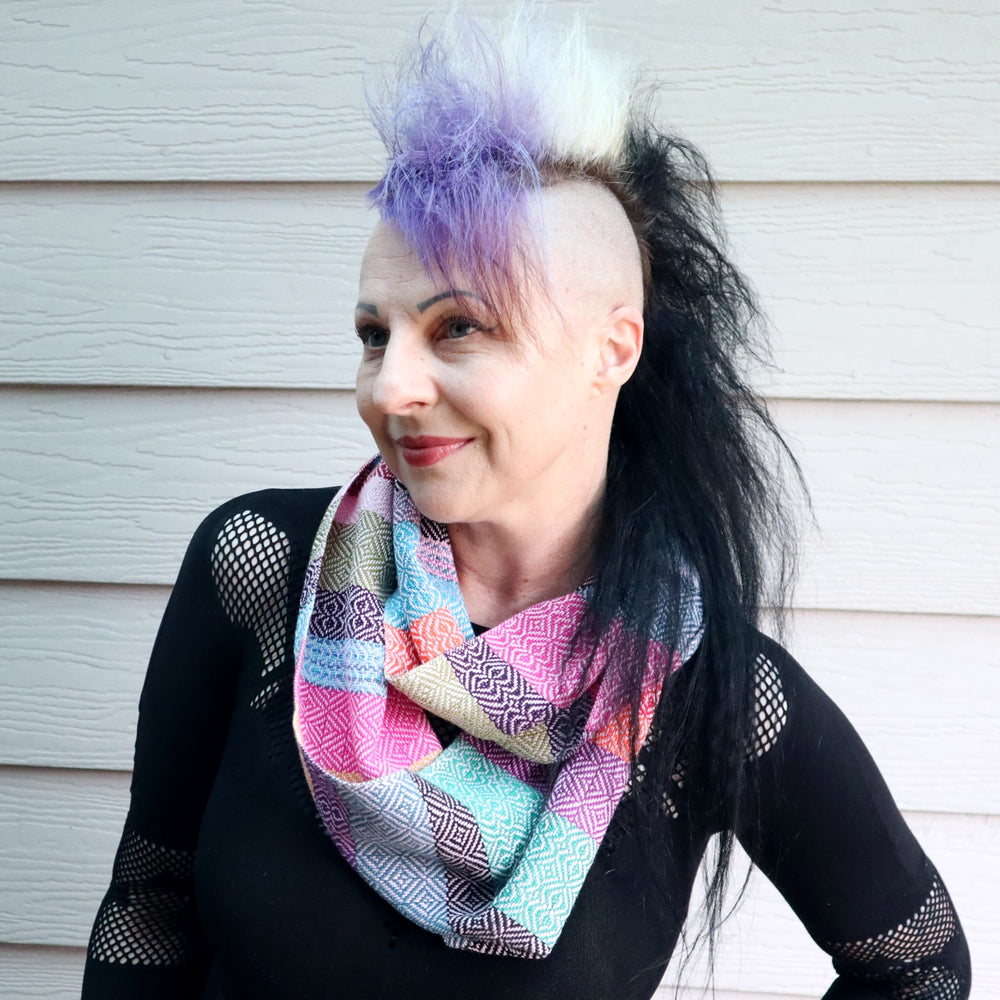
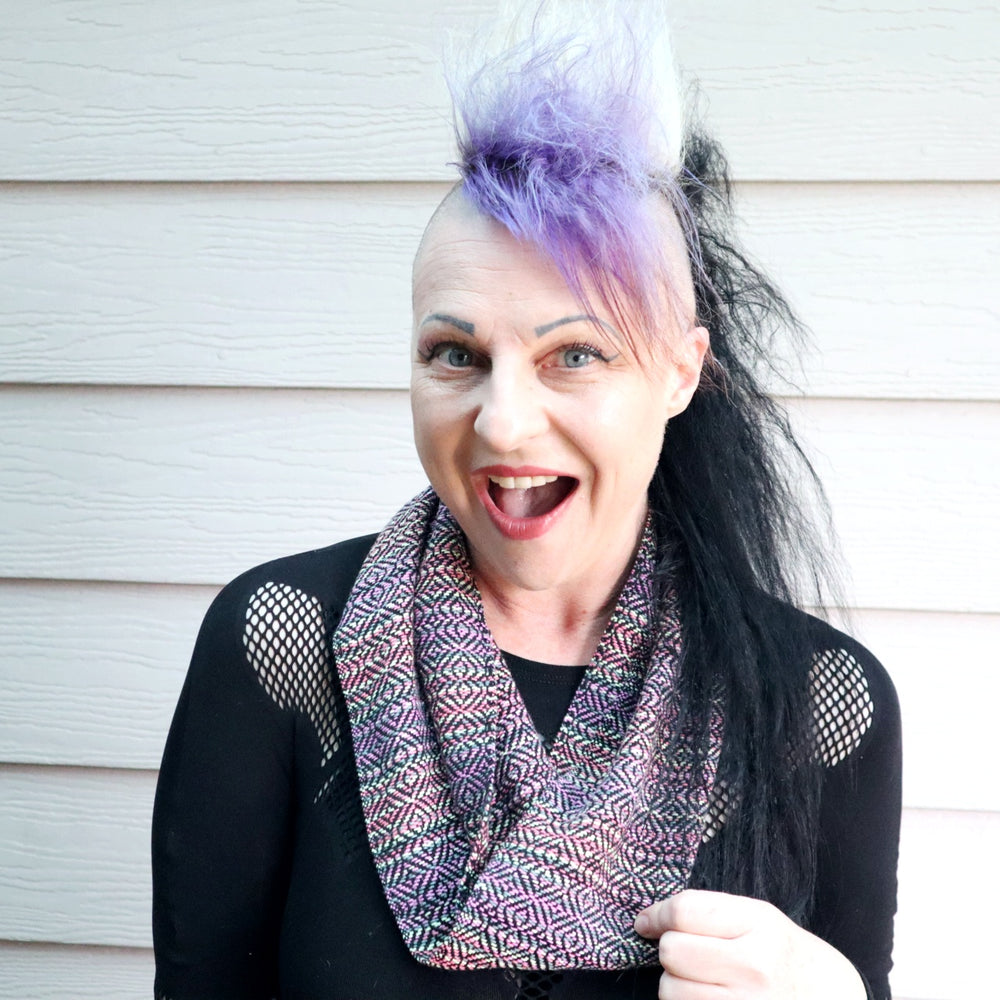
The small variations you'll notice in a handwoven scarf - a subtle shift in texture here, a colour that reads slightly differently in different light, a density that changes almost imperceptibly from one end to the other - those aren't flaws. They're the record of a human being present at a loom for the entire length of the piece.
No two come off exactly the same. Not because that's a nice thing to say, but because physics won't allow it.
The Materials Actually Matter Too
Cotton, when it's good cotton, has a weight and drape that synthetics spend a lot of money trying to imitate. The scarves here are woven in fine cotton, the kind that softens with washing, that gets better the more you wear it, that doesn't pill or go weird after a season.
There's no coating making it feel soft in your hands right now that will wash out by winter. What you feel is what it is. What it is gets better over time.
This is the part that's almost impossible to explain about quality materials until you've experienced the alternative enough times. The $19.95 scarf feels fine on day one. By day thirty it's a different object. A well-made cotton scarf at $190 is the same object five years from now - just more itself.
So Where Does the $190 Actually Go?
Not into a massive margin, I'll tell you that.
It goes into the hours of warping and weaving that can't be shortened without compromising the fabric. It goes into cotton that isn't trying to be something it isn't. It goes into the studio, the loom maintenance, the years of learning how to read a piece of cloth while it's still on the loom and know whether it's right.
14 years of perfecting my craft, and counting!
It goes into the fact that when this scarf is gone, there isn't another one exactly like it waiting in a warehouse somewhere.
You're not paying for a brand name or a logo or a shopping bag with rope handles. You're paying for the actual thing - the hours, the material, the hands, the decisions.
What You're Actually Wearing When You Put One On
This is the part that's harder to explain on a product page.
A handwoven scarf isn't just a thing that keeps your neck warm. You probably have things that keep your neck warm. What you might not have is something that feels like it was made for a person like you - specific, considered, not trying to appeal to everyone.
There's a particular feeling that comes with wearing something handmade. Not the performative version - not the "I need to tell people this is artisan" version. The quiet version. The one where you put it on in the morning and something just settles.
It's the same feeling as owning one really good mug instead of six mediocre ones. Or finally replacing the cheap thing you've been tolerating for three years with the right thing. A small recalibration. A reminder that you're allowed to have things that are actually good.
For a lot of people - particularly people who spent a long time being practical, being responsible, making the sensible choice - that feeling is rarer than it should be.
The "I'll Treat Myself Eventually" Trap
Here's the thing about eventually.
Eventually is where good things go to not happen. Eventually is the drawer where the cheap scarf lives, the one you bought because you needed something and this was fine and you'd get a better one later.
Later has a habit of looking exactly like now, just with more regret about the things you didn't let yourself have.
A $190 scarf is not an extravagance for someone who wears scarves. It's the correct price for the correct object, bought once, worn for years, never resented.
The $19.95 one costs more in the long run. Not just in replacement costs - in the low-level, barely-conscious feeling of wearing something that doesn't quite represent you. That feeling has a cost too. It just doesn't show up on a receipt.
This Is Not For Everyone. Genuinely.
If you want something that matches everything and offends no one, these aren't your scarves.
The people who wear these tend to have a point of view. They wear colour when they feel like it and black when they don't. They've stopped buying things they don't actually love just to fill a gap. They're not interested in fast fashion's version of edge - the kind that looks the same on everyone who bought it that season.
They want the thing that's actually theirs.
Not because it has their name on it. Because it doesn't look like anyone else's. Because it came off a loom in Adelaide, woven by one person who was thinking about the cloth the entire time it was being made.
That's what $190 buys you.
Not a scarf. Your scarf.
So. Is It Worth It?
Only you can answer that.
But here's what I'd offer: the question isn't really "is this scarf worth $190." The question is whether you're ready to stop buying the version of things that almost works, and start owning the version that actually does.
If you've been wearing things that are fine, living with things that'll do, tolerating the gap between what you have and what you actually want - a scarf isn't going to fix that.
But it's a place to start.
One really good thing, chosen deliberately, that you'll reach for every time.
That's what's available here. Not a product. Not a unit. Something made slowly, by hand, in Adelaide, by one person who was paying attention the entire time.
If that's what you're looking for, you're in the right place.
Browse the current collection HERE. No two pieces are exactly the same - when they're gone, they're gone.